

Minnesota sees a decrease in opioid overdose deaths over the past three years
News Release
Oct. 27, 2026
A new data report from the Minnesota Department of Health (MDH) shows that Minnesota saw another small decrease in opioid-involved deaths in 2025, which is the third year with a decrease. Opioid-involved overdose deaths have gradually declined from a high of 1,039 in 2022 to 671 in 2025.
Fentanyl-involved deaths in Minnesota saw a 6% decrease from 602 to 564 between 2024 and 2025. All opioid-involved overdose deaths dropped from 678 to 671 during that year, and nonfatal opioid-involved overdose hospitalizations fell from 3,685 to 3,617 between 2024 and 2025, according to MDH’s Statewide Trends in Drug Overdose: 2025 Data Update (PDF).
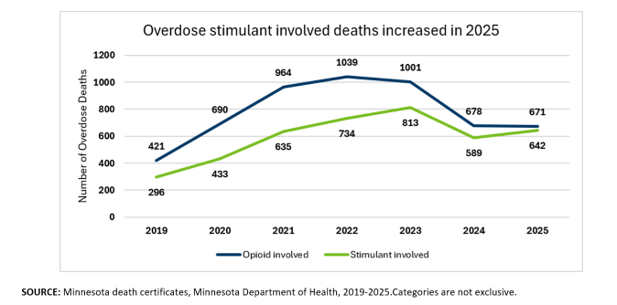
While opioid overdose deaths decreased, the latest data show a 3% increase among all drug overdose deaths (from 994 in 2024 to 1,025 in 2025), which was driven by an increase in stimulant-involved deaths. Hospitalizations for nonfatal overdoses involving stimulants such as methamphetamine and cocaine also increased. For every one Minnesotan who died of a drug overdose in 2025, 14 were treated in a Minnesota hospital and survived a drug overdose.
“We continue to see progress on preventing deadly opioid overdoses with our comprehensive public health approach involving prevention, naloxone, treatment, harm reduction and recovery services,” said Minnesota Commissioner of Health Dr. Brooke Cunningham. “We must continue to advance these efforts, while applying our learnings to address the growing health impacts of increased use of stimulants like cocaine and methamphetamine.”
As part of Minnesota’s opioid prevention efforts, on Oct. 1, MDH, in partnership with the Minnesota Office of Emergency Medical Services (OEMS), launched the MN-OD-ALERTS (Minnesota Overdose Alert, Local Engagement, Response, and Tracking System), a statewide overdose response system that detects spikes, clusters and novel drug threats in near real-time. This important tool was made possible by a proposal brought forward by Governor Walz and funded by the legislature.
MN-OD-ALERTS uses emergency medical services (EMS) data from OEMS to track opioid overdose trends. Once a potential opioid overdose spike is detected, MDH staff review patient-level details and other data, such as hospital visits and community partner reports, to assess whether the spike reflects a meaningful change in overdose activity at the county level. If so, local and Tribal public health partners are notified and can launch a local response with support from the MN-OD-Alerts Community Response Guide (PDF). Counties have shown strong interest in MN-OD-ALERTS with 76 of Minnesota's 87 counties providing a contact for the alert system.
“Emergency medical services (EMS) providers are often the first to see when something is changing in a community,” said Dylan Ferguson, director of Office of Emergency Medical Services. “By using EMS data to identify emerging overdose trends, MN-OD-ALERTS gives public health and community partners an opportunity to act earlier, before a concerning trend becomes a larger crisis. This is an important example of how the information collected by EMS can be used not only to care for individual patients, but also to help protect the health of entire communities.”
During the Gov. Tim Walz administration, Minnesota employed a public health plan focused on prevention, treatment and recovery. The state has made naloxone, which reverses many opioid overdoses, more accessible to first responders and easier to get in places like schools, libraries, shelters and community organizations. Minnesota has also improved real‑time tracking of overdoses so communities can respond faster, through efforts such as MN-OD-ALERTS and the Minnesota Drug Overdose and Substance Use Surveillance Activity (MNDOSA).
Additionally, Minnesota expanded access to medication for opioid use disorder (MOUD) in clinics, jails and Tribal health programs. Minnesota’s Comprehensive Drug Overdose and Morbidity Prevention Act and opioid settlement funds were also used to support effective programs such as linking to culturally specific treatments and care, prevention programming, peer recovery services and syringe service programs.
“Programs like these make a difference and are needed to protect communities as we see new threats and substances emerge,” said Commissioner Cunningham. “We can all play a role in preventing overdoses and substance use disorder and supporting recovery, whether we are policy makers, healthcare workers or community members.”
The new data report also highlights steps that groups like policy makers, healthcare professionals, public health and prevention professionals, and every day Minnesotans can take to decrease overdose deaths and substance use. Those include enhancing local data collection, educating patients and residents, carrying naloxone, and calling 988 Minnesota Lifeline for free support related to mental health, alcohol or drug use.
For more information, see MDH’s Drug Overdose Prevention website.
-MDH-
Media inquiries:
Scott Smith
MDH Communications
651-503-1440
scott.smith@state.mn.us
Legal Disclaimer:
EIN Presswire provides this news content "as is" without warranty of any kind. We do not accept any responsibility or liability for the accuracy, content, images, videos, licenses, completeness, legality, or reliability of the information contained in this article. If you have any complaints or copyright issues related to this article, kindly contact the author above.
